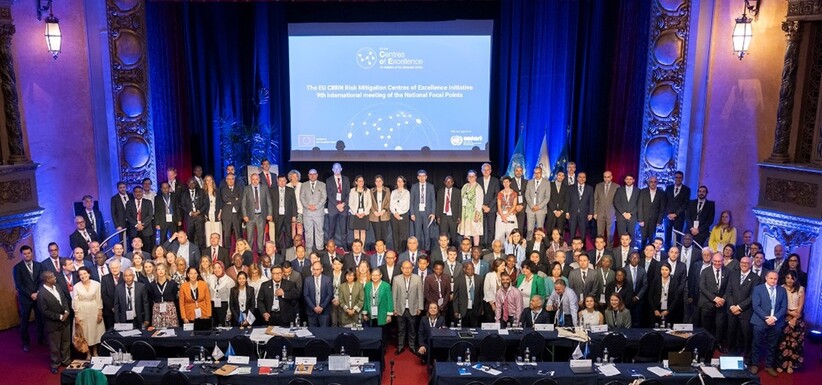
The European Union CBRN Risk Mitigation Centres of Excellence Initiative, a unique approach to tackle CBRN risks
Making the world a safer place
In recent years, the global CBRN risk landscape has evolved significantly due to many different and often converging factors including new risks and threats stemming from rapid technological developments. Threats are posed by the intentional, accidental or naturally occurring release of conventional and new types of chemical, biological, radiological and nuclear (CBRN) materials or agents.
A strong partnership with third countries is important to promote a global culture of CBRN safety and security by strengthening an all-hazards security governance. This, in turn, contributes to CBRN threat resilience worldwide.
In 2010 the European Union (EU) has established the EU CBRN Risk Mitigation Centres of Excellence (CoE) Initiative to support CBRN risk mitigation on a global scale through a wide range of CBRN actions. The Initiative is jointly implemented by the EU and UNICRI and counts 64 Partner Countries grouped in 8 regions, representing the EU’s largest civilian external security programme.
The CoE network supports the mitigation of and preparedness against CBRN risks by fostering good governance in the domain, enhancing regional and international multi-agency cooperation, and facilitating the transfer of best practices. The bottom-up and demand-oriented nature of the activities carried out within the network, ensure that the support provided is sustainably tailored to countries’ and regions’ needs.
Through the CoE Initiative and the projects implemented, good progress has been done in each region:
Additional information can be found here: https://cbrn-risk-mitigation.network.europa.eu/index_en
Questions may be directed to FPI-1@ec.europa.eu
Until now, more than 100 capacity-building projects have been funded, 30 countries received support to strengthen the good governance of CBRN risks through the creation of inter-agency CBRN national teams and the development of CBRN national action plans.
BIOSECURITY THREAT ASSESSMENT IN LATIN AMERICA: CICTE/OAS AND UNIVERSITY OF MARYLAND LAUNCHED NEW RESEARCH PUBLICATIONS
While the level of terrorist threats to biosecurity in Latin America remains relatively low, implementing internal measures and national biosafety and biosecurity regulations in laboratories and research centers is crucial. This is an essential step to prevent both intentional and unintentional biological accidents, mitigate risks, and prepare adequate responses in the event of an accident. Despite the experiences of the H1N1 epidemic in 2009 and the more recent COVID-19 pandemic, the region has shown vulnerability to biological threats.
The project titled "Strengthening Biosafety and Biosecurity in Latin America in line with Resolution 1540," conducted over the past years by the Inter-American Committee against Terrorism of the Organization of American States (CICTE/OAS) with the support of the European Union, aimed to lay the foundations for a stronger biosafety culture. The project also sought to create a Latin American network of expertise and strengthen biosafety and biosecurity standards and measures across the region.
In the context of the project, CICTE/OAS collaborated with the National Consortium for the Study of Terrorism and Responses to Terrorism (START) at the University of Maryland. This collaboration resulted in the development of two free online courses in Spanish for laboratory personnel and, more recently, a series of publications showcasing the findings and results of a regional survey of potential biosecurity threats in Latin America.
This two-pronged effort included a comprehensive biosecurity threat assessment of the Central and South American region and four country-level threat assessments for Chile, Colombia, Dominican Republic and Panama. These texts, in Spanish and English, provide a high-level assessment of the region for policy-focused individuals and those responsible for working in or managing the activities of laboratories, reviewing the current situation and assessing future challenges.
By way of background, a 2013 initial publication issued in Spanish, covered the scope and interrelationship of various biosafety and biosecurity concepts, existing international obligations to biosecurity through the Biological Weapons Convention (BWC) and UN Security Council Resolution 1540, the application of biosecurity across different facility types, and biosecurity risks such as proliferation, bioterrorism, agroterrorism, and bio-crime. Additionally, the publication discusses the five pillars and mechanisms of biosecurity and their application in the region.
The four countries featured in these studies have demonstrated a strong commitment to bio-risk reduction at all levels of the public and private sectors in creating safer environments. CICTE/OAS has facilitated cooperation within various funded programs, including peer review exercises and sub-regional and national workshops on biosafety and biosecurity. These reports aim to contribute to further strengthening controls and developing safer activities in handling biological agents to reduce security risks.
It is expected that these works will serve as effective tools for other countries in the region moving in a similar direction, aiding them in consolidating regulatory and control mechanisms in accordance with established international standards. CICTE/OAS expresses gratitude to the experts who participated in the project, sharing their knowledge and experiences, as well as the national authorities of all the involved countries for their trust, solid commitment, and ongoing work in strengthening compliance with international obligations.
Through these publications, CICTE/OAS reaffirms its traditional institutional support for the international disarmament and non-proliferation regime. The organization continues to express its willingness to collaborate in efforts aimed at ensuring greater regional security from multiple perspectives for all countries in the Americas.
The publications can be found and downloaded here: https://www.oas.org/ext/es/seguridad/unscr1540


The European Union CBRN Risk Mitigation Centres of Excellence Initiative, a unique approach to tackle CBRN risks
In recent years, the global CBRN risk landscape has evolved significantly due to many different and often converging factors including new risks and threats stemming from rapid technological developments. Threats are posed by the intentional, accidental or naturally occurring release of conventional and new types of chemical, biological, radiological and nuclear (CBRN) materials or agents.
A strong partnership with third countries is important to promote a global culture of CBRN safety and security by strengthening an all-hazards security governance. This, in turn, contributes to CBRN threat resilience worldwide.
In 2010 the European Union (EU) has established the EU CBRN Risk Mitigation Centres of Excellence (CoE) Initiative to support CBRN risk mitigation on a global scale through a wide range of CBRN actions. The Initiative is jointly implemented by the EU and UNICRI and counts 64 Partner Countries grouped in 8 regions, representing the EU’s largest civilian external security programme.
The CoE network supports the mitigation of and preparedness against CBRN risks by fostering good governance in the domain, enhancing regional and international multi-agency cooperation, and facilitating the transfer of best practices. The bottom-up and demand-oriented nature of the activities carried out within the network, ensure that the support provided is sustainably tailored to countries’ and regions’ needs.
Until now, more than 100 capacity-building projects have been funded, 30 countries received support to strengthen the good governance of CBRN risks through the creation of inter-agency CBRN national teams and the development of CBRN national action plans.
Through the CoE Initiative and the projects implemented, good progress has been done in each region:
Additional information can be found here: https://cbrn-risk-mitigation.network.europa.eu/ index_en
Questions may be directed to: FPI-1@ec.europa.eu
Making the world a safer place
One of the main focus of the EU-funded project is delivering in-person workshops. In the last six months, OAS/CICTE carried out seven face-to-face training courses for laboratory personnel and scientists from the live science fields. These workshops were designed to increase awareness of bio-risks and to strengthen knowledge on the challenges concerning biological safety and security. These courses took place, respectively, in Asuncion (Paraguay) from 17 to 21 April, Panama City (Panama) from 5 to 9 June, Santo Domingo (Dominican Republic) from 17 to 21 July, Bogotá (Colombia) from 24 to 28 July, Buenos Aires (Argentina) from 7 to 11 August, Montevideo (Uruguay) from 8 to 11 August, and Santiago (Chile) from 4 to 8 September. On average, some 30 participants from public or private institutions and research centers attended each of these courses.
Training in Santo Domingo, Dominican Republic, July 17-21, 2023 Professionals from: 12 laboratories, 7 hospitals, 4 health government agencies and 11 academia