

Country-Driven approaches to sustainable biological risk management: case studies of Malawi and Kenya
In support of the Signature Initiative to Mitigate Biological Threats in Africa (SIMBA), and with funding from Global Affairs Canada’s Weapons Threat Reduction Program, the World Organisation for Animal Health (WOAH) is actively supporting selected countries in Africa to enhance their biological risk management capacities through the Fortifying Institutional Resilience Against Biological Threats (FIRABioT) Project. Recent initiatives in Malawi and Kenya highlight the importance of tailored, country-driven, and country-owned approaches, to sustainable management of biological risks in veterinary laboratories and field animal health operations.
Malawi's comprehensive biorisk management manuals for veterinary laboratories
In October 2023, as part of its national workplan under the FIRABioT project, Malawi held a national training on biosafety and biosecurity in animal health laboratories. Following this training, veterinary laboratories in Malawi conducted their own biological risk assessments and subsequently requested support with developing laboratory biological risk management manuals.
Based on biological risk assessments, staff of the central and regional veterinary laboratories developed draft laboratory biological risk management manuals. Following this, a 2-week mission by WOAH experts was conducted from February 17 to 28, 2025.
The mission began with field visits to the Blantyre Regional Veterinary Laboratory (BRVL), Mzuzu Regional Veterinary Laboratory (MRVL), and the Central Veterinary Laboratory (CVL). During these visits, WOAH experts worked with the staff to conduct biological risk assessments, identified gaps, and proposed mitigation measures. They worked with each laboratory’s staff to edit and finalise laboratory-specific biological risk management manuals that had been drafted by the laboratory staff ahead of the mission.
BIOSECURITY THREAT ASSESSMENT IN LATIN AMERICA: CICTE/OAS AND UNIVERSITY OF MARYLAND LAUNCHED NEW RESEARCH PUBLICATIONS
While the level of terrorist threats to biosecurity in Latin America remains relatively low, implementing internal measures and national biosafety and biosecurity regulations in laboratories and research centers is crucial. This is an essential step to prevent both intentional and unintentional biological accidents, mitigate risks, and prepare adequate responses in the event of an accident. Despite the experiences of the H1N1 epidemic in 2009 and the more recent COVID-19 pandemic, the region has shown vulnerability to biological threats.
The project titled "Strengthening Biosafety and Biosecurity in Latin America in line with Resolution 1540," conducted over the past years by the Inter-American Committee against Terrorism of the Organization of American States (CICTE/OAS) with the support of the European Union, aimed to lay the foundations for a stronger biosafety culture. The project also sought to create a Latin American network of expertise and strengthen biosafety and biosecurity standards and measures across the region.
In the context of the project, CICTE/OAS collaborated with the National Consortium for the Study of Terrorism and Responses to Terrorism (START) at the University of Maryland. This collaboration resulted in the development of two free online courses in Spanish for laboratory personnel and, more recently, a series of publications showcasing the findings and results of a regional survey of potential biosecurity threats in Latin America.
This two-pronged effort included a comprehensive biosecurity threat assessment of the Central and South American region and four country-level threat assessments for Chile, Colombia, Dominican Republic and Panama. These texts, in Spanish and English, provide a high-level assessment of the region for policy-focused individuals and those responsible for working in or managing the activities of laboratories, reviewing the current situation and assessing future challenges.
By way of background, a 2013 initial publication issued in Spanish, covered the scope and interrelationship of various biosafety and biosecurity concepts, existing international obligations to biosecurity through the Biological Weapons Convention (BWC) and UN Security Council Resolution 1540, the application of biosecurity across different facility types, and biosecurity risks such as proliferation, bioterrorism, agroterrorism, and bio-crime. Additionally, the publication discusses the five pillars and mechanisms of biosecurity and their application in the region.
The four countries featured in these studies have demonstrated a strong commitment to bio-risk reduction at all levels of the public and private sectors in creating safer environments. CICTE/OAS has facilitated cooperation within various funded programs, including peer review exercises and sub-regional and national workshops on biosafety and biosecurity. These reports aim to contribute to further strengthening controls and developing safer activities in handling biological agents to reduce security risks.
It is expected that these works will serve as effective tools for other countries in the region moving in a similar direction, aiding them in consolidating regulatory and control mechanisms in accordance with established international standards. CICTE/OAS expresses gratitude to the experts who participated in the project, sharing their knowledge and experiences, as well as the national authorities of all the involved countries for their trust, solid commitment, and ongoing work in strengthening compliance with international obligations.
Through these publications, CICTE/OAS reaffirms its traditional institutional support for the international disarmament and non-proliferation regime. The organization continues to express its willingness to collaborate in efforts aimed at ensuring greater regional security from multiple perspectives for all countries in the Americas.
The publications can be found and downloaded here: https://www.oas.org/ext/es/seguridad/unscr1540


Country-Driven approaches to sustainable biological risk management: case studies of Malawi and Kenya
In support of the Signature Initiative to Mitigate Biological Threats in Africa (SIMBA), and with funding from Global Affairs Canada’s Weapons Threat Reduction Program, the World Organisation for Animal Health (WOAH) is actively supporting selected countries in Africa to enhance their biological risk management capacities through the Fortifying Institutional Resilience Against Biological Threats (FIRABioT) Project. Recent initiatives in Malawi and Kenya highlight the importance of tailored, country-driven, and country-owned approaches, to sustainable management of biological risks in veterinary laboratories and field animal health operations.
Malawi's comprehensive biorisk management manuals for veterinary laboratories
In October 2023, as part of its national workplan under the FIRABioT project, Malawi held a national training on biosafety and biosecurity in animal health laboratories. Following this training, veterinary laboratories in Malawi conducted their own biological risk assessments and subsequently requested support with developing laboratory biological risk management manuals.
Based on biological risk assessments, staff of the central and regional veterinary laboratories developed draft laboratory biological risk management manuals. Following this, a 2-week mission by WOAH experts was conducted from February 17 to 28, 2025.
The mission began with field visits to the Blantyre Regional Veterinary Laboratory (BRVL), Mzuzu Regional Veterinary Laboratory (MRVL), and the Central Veterinary Laboratory (CVL). During these visits, WOAH experts worked with the staff to conduct biological risk assessments, identified gaps, and proposed mitigation measures. They worked with each laboratory’s staff to edit and finalise laboratory-specific biological risk management manuals that had been drafted by the laboratory staff ahead of the mission.
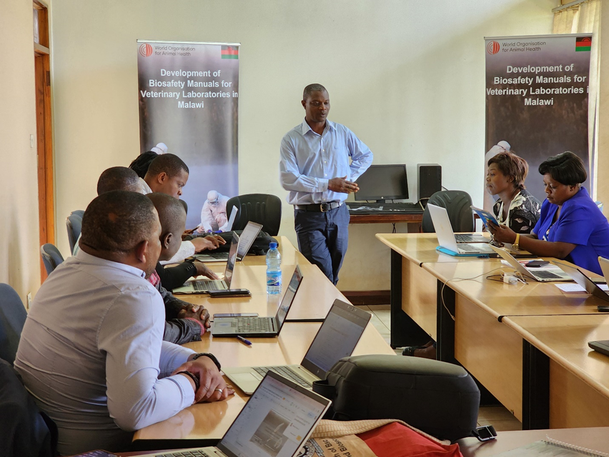
All three laboratories then participated in a writeshop at the Central Veterinary Laboratory in Lilongwe. They consolidated the lab-specific documents into a comprehensive national biological risk management manual. The writeshop also included training sessions on standard operating procedure (SOP) writing and pathogen risk assessment, addressing identified gaps across the laboratories.
The mission highlighted several easily implementable and sustainable biological risk management measures for each laboratory, and areas of good practice that can be scaled across Malawi. Taking a participatory approach to drafting the Laboratory Biological Risk Manuals ensures that they are tailored to each laboratory’s unique situation for easy implementation and sustainability. It also supports the development of sustainable skills in risk analysis.
“The training benefitted me in a specific way that it helped to remind us of the need to start taking biosafety at the lab more seriously and that it is possible to set up a biosafety program even with the available resources we have.”
Following this drafting mission, the draft guidelines will be shared with the relevant national and regional stakeholders for their input ahead of the validation workshop scheduled for the end of April 2025.
Kenya's biological risk management for field animal health service providers
Field animal health service providers are equally vulnerable to zoonotic diseases spread by close contact with diseased animals or their bodily fluids but are often neglected in risk management policies. During routine veterinary procedures such as immunisations, examinations, specimen collection and surgical operations, common zoonotic infections such as Salmonella, Leptospira, and Brucella can be spread through ingestion, inhalation, or cutaneous exposure. These challenges are compounded by the lack of reliable biological waste disposal facilities which can contaminate the environment and increase the risk of disease transmission to other animals and humans. Additionally, in the event of a disease investigation, whether the outbreak is natural, accidental, or of deliberate origin, field animal health service providers are often the first responders, placing them at even greater risk due to potential exposure to infectious disease agents in uncontrolled settings.
Thus, as part of its national workplan, Kenya requested support with developing biological risk management guidelines for field animal health service providers. WOAH organised a drafting workshop from March 10 to 14, 2025 in Mombasa, Kenya, bringing together 25 participants from national animal health organisations, including the Directorate of Veterinary Services, veterinary laboratories, research institutes, academia, and county veterinary departments.
On day one, the participants developed the detailed structure and outline of the guidelines. Drafting groups, each facilitated by a WOAH expert, were then formed and assigned chapters of the guidelines. Within the groups, each participant was assigned a sub-section based on their expertise, for which they developed an initial draft. These initial draft sub-sections received feedback within the groups before consolidating the respective chapters for plenary presentations and feedback. Over the following 4 days, three rounds of drafting and two plenary presentations were conducted.
“It was a refreshing experience to start the process with no predetermined structure.”
“Usually, the creation of documents takes 2 years. So, this activity was very efficient”
Following this drafting workshop, the draft guidelines will be shared with the relevant national and regional stakeholders for their input ahead of the validation workshop scheduled for July 2025. These guidelines aim to ensure safety during field operations and reduce the risks of agro-crime and agro-terrorism by ensuring safe handling and storage of biological agents.
These initiatives in Malawi and Kenya demonstrate the effectiveness of country-driven approaches to biological risk management, tailored to the specific needs and contexts of each country. It fosters country ownership and builds the expertise of the participating national stakeholders as they apply themselves to the process. Additionally, the close interaction with the content eases buy-in, roll out and implementation of the developed documents. The workshops, together with feedback on the outcomes, will form a blueprint for further strengthening biological risk management in laboratory and field settings across the African continent. These efforts contribute significantly to global health security and the mitigation of biological threats, serving as a direct contribution to strengthening the animal health component of the Signature Initiative to Mitigate Biological Threats in Africa (SIMBA).
One of the main focus of the EU-funded project is delivering in-person workshops. In the last six months, OAS/CICTE carried out seven face-to-face training courses for laboratory personnel and scientists from the live science fields. These workshops were designed to increase awareness of bio-risks and to strengthen knowledge on the challenges concerning biological safety and security. These courses took place, respectively, in Asuncion (Paraguay) from 17 to 21 April, Panama City (Panama) from 5 to 9 June, Santo Domingo (Dominican Republic) from 17 to 21 July, Bogotá (Colombia) from 24 to 28 July, Buenos Aires (Argentina) from 7 to 11 August, Montevideo (Uruguay) from 8 to 11 August, and Santiago (Chile) from 4 to 8 September. On average, some 30 participants from public or private institutions and research centers attended each of these courses.
Training in Santo Domingo, Dominican Republic, July 17-21, 2023 Professionals from: 12 laboratories, 7 hospitals, 4 health government agencies and 11 academia


All three laboratories then participated in a writeshop at the Central Veterinary Laboratory in Lilongwe. They consolidated the lab-specific documents into a comprehensive national biological risk management manual. The writeshop also included training sessions on standard operating procedure (SOP) writing and pathogen risk assessment, addressing identified gaps across the laboratories.
The mission highlighted several easily implementable and sustainable biological risk management measures for each laboratory, and areas of good practice that can be scaled across Malawi. Taking a participatory approach to drafting the Laboratory Biological Risk Manuals ensures that they are tailored to each laboratory’s unique situation for easy implementation and sustainability. It also supports the development of sustainable skills in risk analysis.
“The training benefitted me in a specific way that it helped to remind us of the need to start taking biosafety at the lab more seriously and that it is possible to set up a biosafety program even with the available resources we have.”
Following this drafting mission, the draft guidelines will be shared with the relevant national and regional stakeholders for their input ahead of the validation workshop scheduled for the end of April 2025.
Kenya's biological risk management for field animal health service providers
Field animal health service providers are equally vulnerable to zoonotic diseases spread by close contact with diseased animals or their bodily fluids but are often neglected in risk management policies. During routine veterinary procedures such as immunisations, examinations, specimen collection and surgical operations, common zoonotic infections such as Salmonella, Leptospira, and Brucella can be spread through ingestion, inhalation, or cutaneous exposure. These challenges are compounded by the lack of reliable biological waste disposal facilities which can contaminate the environment and increase the risk of disease transmission to other animals and humans. Additionally, in the event of a disease investigation, whether the outbreak is natural, accidental, or of deliberate origin, field animal health service providers are often the first responders, placing them at even greater risk due to potential exposure to infectious disease agents in uncontrolled settings.
Thus, as part of its national workplan, Kenya requested support with developing biological risk management guidelines for field animal health service providers. WOAH organised a drafting workshop from March 10 to 14, 2025 in Mombasa, Kenya, bringing together 25 participants from national animal health organisations, including the Directorate of Veterinary Services, veterinary laboratories, research institutes, academia, and county veterinary departments.
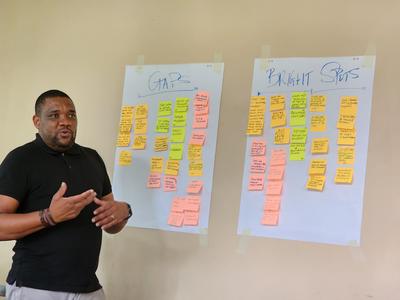
WOAH’s collaboration with the Global Partnership and national experts in Malawi and Kenya to develop sustainable and holistic Biological Risk Management practices. A country-driven participatory approach will ensure that national needs are met whilst maximising sustainability.
Dr Joseph Nkhoma, Head of Malawi’s Central Veterinary Laboratory, and Acting Deputy Director for Veterinary Research and Investigations addresses the participants of the writeshop. Photo © I. Busuulwa (woah) 2025
WOAH’s collaboration with the Global Partnership and national experts in Malawi and Kenya to develop sustainable and holistic Biological Risk Management practices. A country-driven participatory approach will ensure that national needs are met whilst maximising sustainability.
Mr James Sakwa (left) and Ms Vimbai Mukondiwa (2nd left) during the tour of Blantyre Regional Veterinary Laboratory. Photo © I. Busuulwa (woah) 2025
Dr Joseph Nkhoma, Head of Malawi’s Central Veterinary Laboratory, and Acting Deputy Director for Veterinary Research and Investigations addresses the participants of the writeshop. Photo © I. Busuulwa (woah) 2025
Participants engaging in group discussions. Picture © I. Busuulwa (woah) 2025.
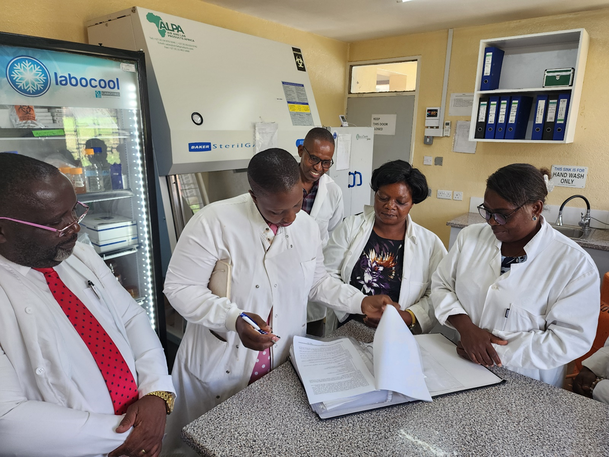
Mr James Sakwa (left) and Ms Vimbai Mukondiwa (2nd left) during the tour of Blantyre Regional Veterinary Laboratory. Photo © I. Busuulwa (woah) 2025
On day one, the participants developed the detailed structure and outline of the guidelines. Drafting groups, each facilitated by a WOAH expert, were then formed and assigned chapters of the guidelines. Within the groups, each participant was assigned a sub-section based on their expertise, for which they developed an initial draft. These initial draft sub-sections received feedback within the groups before consolidating the respective chapters for plenary presentations and feedback. Over the following 4 days, three rounds of drafting and two plenary presentations were conducted.
“It was a refreshing experience to start the process with no predetermined structure.”
“Usually, the creation of documents takes 2 years. So, this activity was very efficient.”
Following this drafting workshop, the draft guidelines will be shared with the relevant national and regional stakeholders for their input ahead of the validation workshop scheduled for July 2025. These guidelines aim to ensure safety during field operations and reduce the risks of agro-crime and agro-terrorism by ensuring safe handling and storage of biological agents.
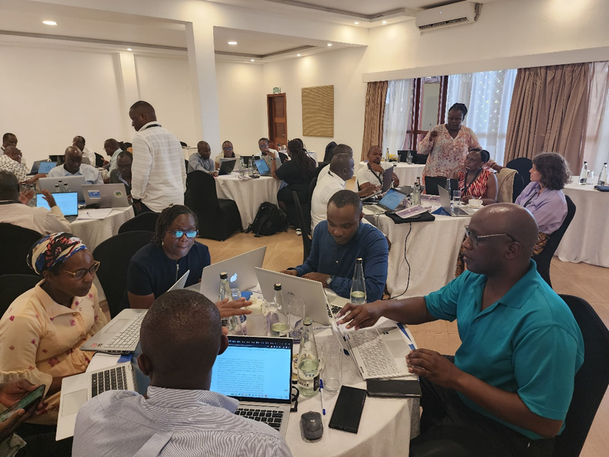
Participants engaging in group discussions. Picture © I. Busuulwa (woah) 2025
These initiatives in Malawi and Kenya demonstrate the effectiveness of country-driven approaches to biological risk management, tailored to the specific needs and contexts of each country. It fosters country ownership and builds the expertise of the participating national stakeholders as they apply themselves to the process. Additionally, the close interaction with the content eases buy-in, roll out and implementation of the developed documents. The workshops, together with feedback on the outcomes, will form a blueprint for further strengthening biological risk management in laboratory and field settings across the African continent. These efforts contribute significantly to global health security and the mitigation of biological threats, serving as a direct contribution to strengthening the animal health component of the Signature Initiative to Mitigate Biological Threats in Africa (SIMBA).